Turn everyday road patrols into digital twin-ready condition data — with the smartphones your crews already carry.
No new hardware, no specialist survey crews. A phone on the windscreen captures video, GPS and vibration on every drive, and the data lands processed and mapped in your Visualisation Portal.
One app, whole-of-network sensing
Traditional road condition surveys are too expensive and too rare — they miss problems between visits and limit how often you can assess the network. The iRoadTech app changes that by turning vehicles you already run — patrol utes, waste trucks, pool cars — into continuous sensing platforms.
The phone becomes the sensor; our AI does the heavy lifting. Advanced models turn the motion felt by the phone into an accurate measure of pavement roughness, while the camera captures the imagery that powers parking sign, pavement defect, and kerb & channel detection.
No new hardware
Replace costly, specialised survey vehicles with the smartphones your team already carries — a mount and the app is the whole kit.
Network-wide reach
Every routine patrol becomes a survey. Continuous, high-frequency monitoring across the entire network — not just sampled corridors.
AI-corrected signal
Trained on real-world data, the AI filters out interference like vehicle type and speed for reliable roughness measurements.
Try the app right here
This is the interactive prototype of the iRoadTech Field Capture app. Click through it below exactly as a patrol crew would use it on the road — or open it full size in its own tab.
Live interactive prototype — tap the buttons.
- Start a survey — choose the route and the asset modules to capture: pavement, kerb & channel, parking signs.
- Drive as normal — the app records video, GPS trace and vibration, while the passenger tags defects with one touch.
- Review the session — check distance covered, captures and tagged assets before anything leaves the phone.
- Sync when ready — upload over Wi-Fi to the AI pipeline; results land in the Visualisation Portal and your digital twin.
Opens in a new browser tab, phone-sized.
Smartphone-based pavement roughness capture in action.
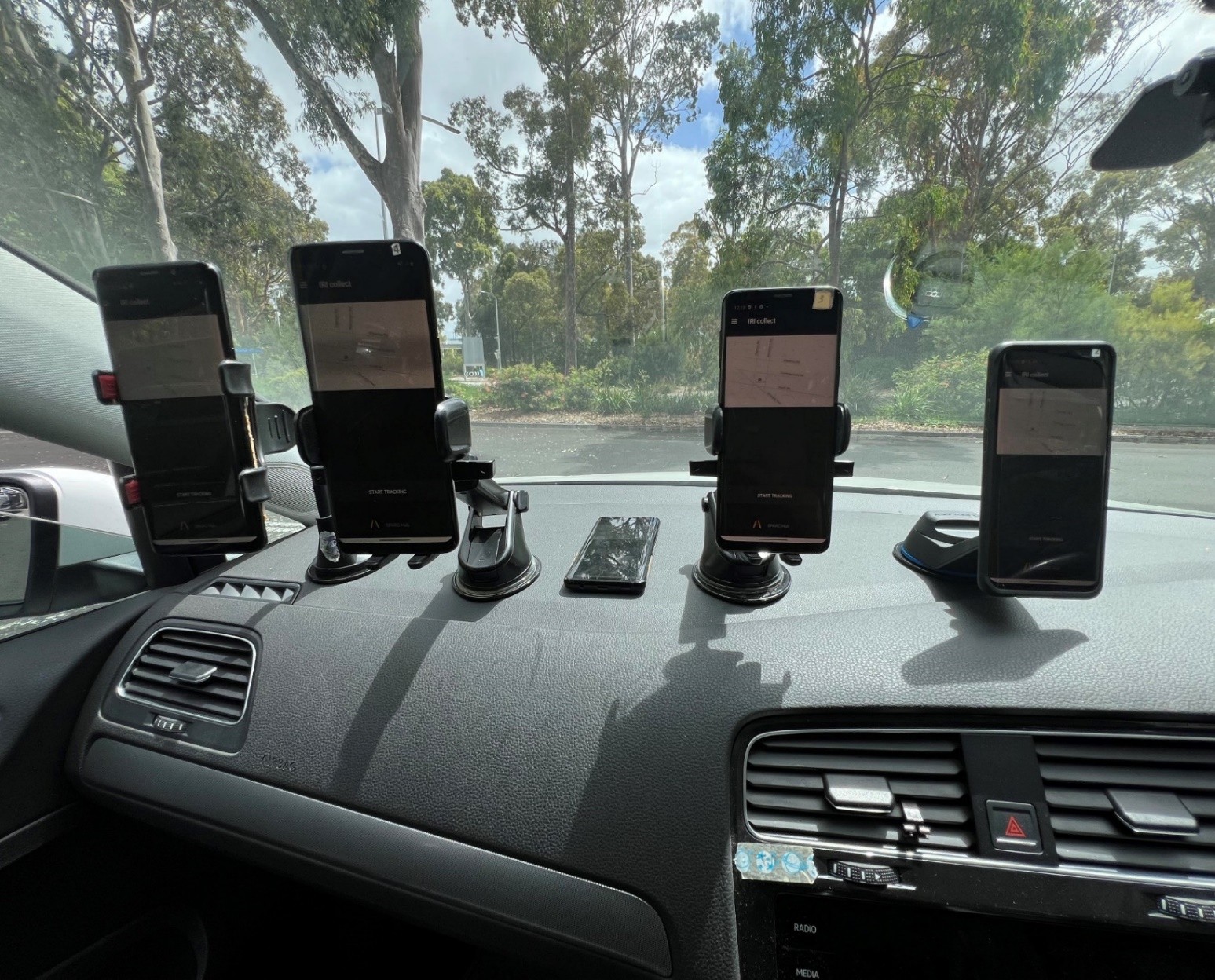
The impact is simple: frequent, precise, and inexpensive data on the condition of your roads — letting you prioritise maintenance efficiently and improve driver safety.
Pair it with
Parking Sign Detection
A phone mounted high on the windscreen gives clear views of overhead and post-mounted signage.
Road Defect Detection
Roughness from the phone's motion sensors plus defect imagery from its camera, captured on the same drive.
Kerb & Channel
A lower mounting angle captures the kerb edge in detail for repeatable condition assessment.